History Has a Water Problem: How Strawbery Banke Museum is Adapting [Podcast]
Show Notes
How do you preserve the past when the future is getting wetter?
Strawbery Banke Museum in Portsmouth, New Hampshire, is facing this question as rising seas, coastal storms and changing rainfall increase the risk of flooding and water damage to its historic buildings.
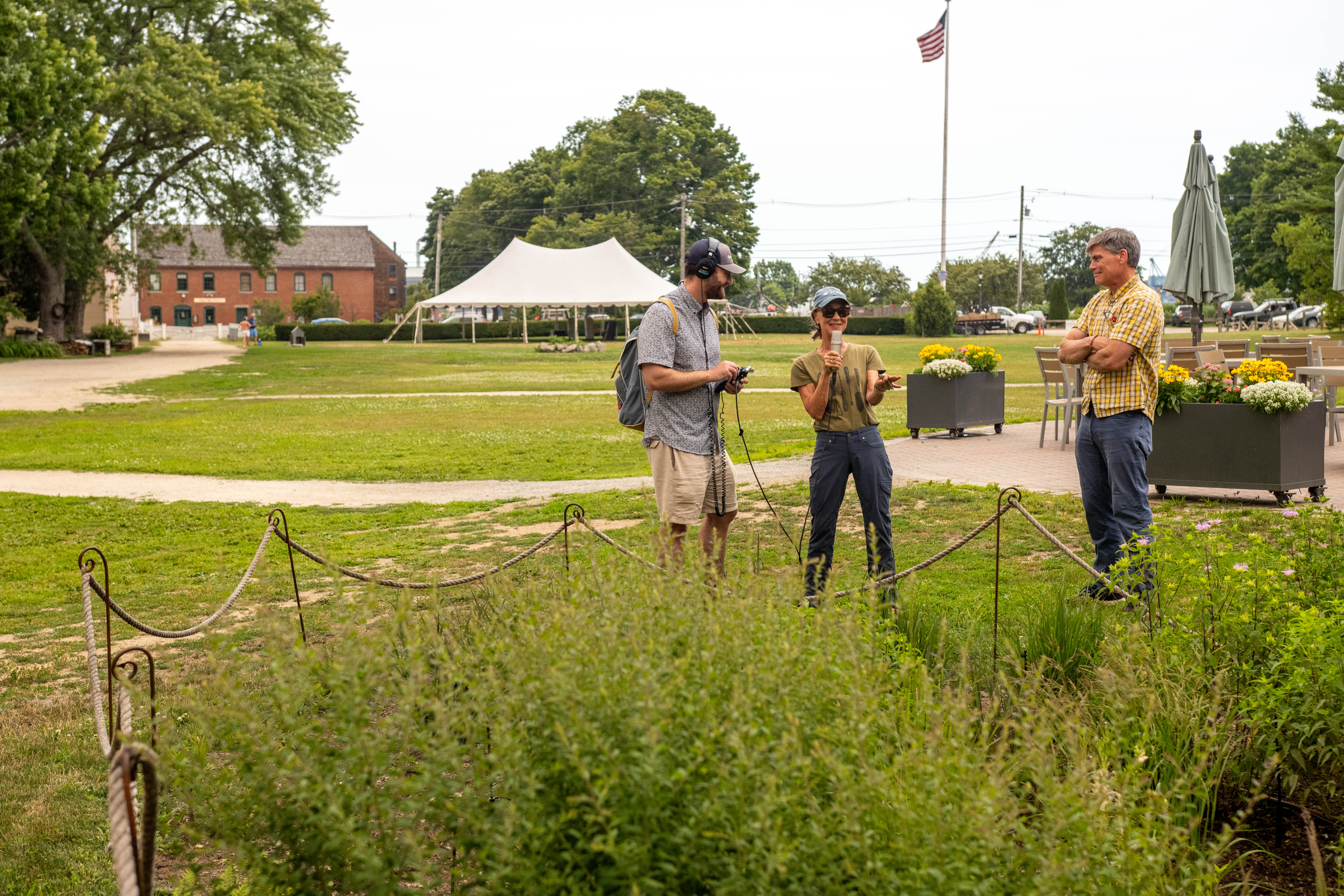
On this episode of Time and Tide, hosts Brian Yurasits and Erik Chapman head to Portsmouth’s historic Puddle Dock to learn how Strawbery Banke is preparing for these changes.
First, Rodney Rowland, the museum’s Director of Environmental Sustainability, shares the history of the neighborhood and explains how this museum is using monitoring, planning, and nature-based solutions to build resilience. What lessons can we learn from the past as we try to protect this same history from a wetter future?
Next, volunteer Tamara Henderson takes us on a tour to explore rain gardens as a natural solution for stormwater management.
This is part one of a two-part episode about a group of people trying to preserve history in New Hampshire, while at the same time looking ahead at a flooded future. On our next episode, we speak with an architect and contractor working with Strawbery Banke and find out what it takes to actually build a better future in a port city.
Full episode transcript is available below.
Guest Speakers
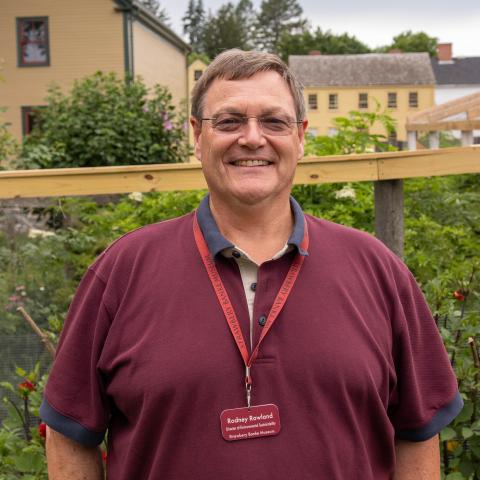
Rodney Rowland
Director of Environmental Sustainability, Strawbery Banke Museum

Tamara Henderson
Volunteer and Trustee, Strawbery Banke Museum
Meet Your Hosts
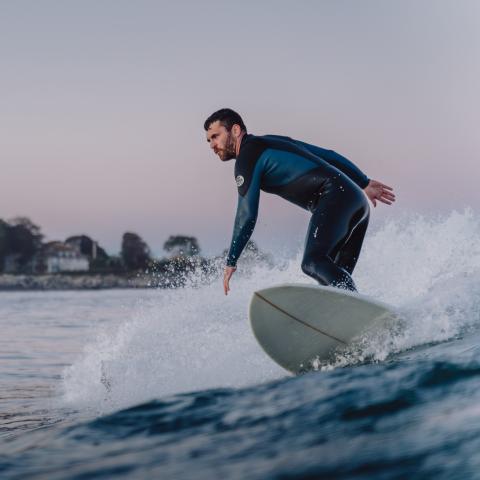
Brian Yurasits,
Host & Producer
Science Communication Specialist,
New Hampshire Sea Grant
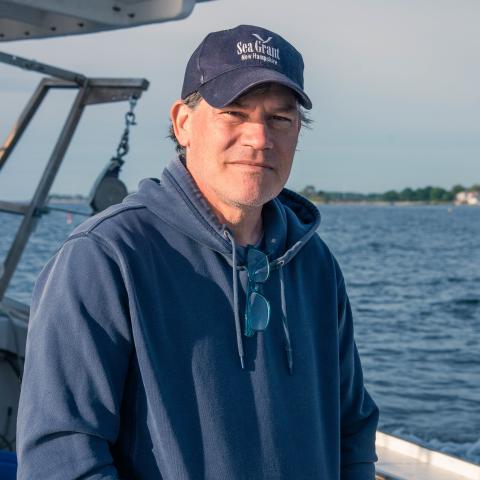
Erik Chapman, Ph.D,
Co-host
Director, New Hampshire Sea Grant
Interim Director, UNH School of Marine Science and Ocean Engineering
More Episodes?
We've got you covered! Time and Tide is available wherever you get your podcasts.
Episode Transcript
Rodney Rowland: [00:00:00] The history of the world is based on water sources. They needed it for food, they needed it for transportation. So all the historic sites typically are on the water, and those areas are just now at risk from sea level rise. Then you come to Strawbery Banke and you realize that the center of our museum, Puddle Dock, used to be a tidal inlet that was filled in.
And then to further complicate things, um, the Piscataqua River, as it gets higher and higher, it's pushing the groundwater, the fresh groundwater up, and that means it's getting into our early basements. All our houses are on the original foundations, or most, and the basements are, what, six feet down? Well, the groundwater's two feet down.
So, you can see how that's a big problem, especially for a very old house on a very old foundation.
Brian Yurasits: Walking through Strawbery Banke Museum in Portsmouth, New [00:01:00] Hampshire will take you on a journey through 12,000 years of local history. From stories of indigenous peoples, through colonization and industrialization, all the way to the present day, the museum allows us a window into the past. But what happens when the goal of preserving the past collides with a need to adapt for a wetter future?
The museum exists because of its relationship with water. For centuries, this neighborhood sat alongside the Piscataqua River in a place once known as Puddle Dock, a tidal inlet that helped to shape Portsmouth's history. But today, that same water is becoming one of the biggest threats to the history Strawbery Banke is trying to preserve.
Rising seas, coastal storms, and changing rainfall patterns are already bringing more water into the museum's historic buildings, where saltwater and groundwater can cause lasting damage, and in the years ahead, those threats will only become worse. So, what do you do when the past you're trying to protect is sitting [00:02:00] in a vulnerable place?
At Strawbery Banke, the answer isn't simply to put up a wall and keep the water out. The museum is exploring what it means to adapt a historic landscape to a wetter future. This involves everything from better monitoring that can help us understand these changes, to designing and engineering solutions that look to nature for inspiration.
One last and very important point is that these solutions to living with a wetter future can't ignore the causes of this change. This isn't just a story about saving old buildings. It's a story about learning from the past while we write our own chapter in New Hampshire's history.
I'm your host, Brian Yurasits, and welcome to Time and Tide, the podcast from New Hampshire Sea Grant where we explore the science, stories, and people behind our changing coastlines.
On today's episode, I'll be joined by my co-host, Erik Chapman, as we head to Portsmouth's historic Puddle Dock to find out how Strawbery Banke is preparing for a future with more water.
In act one, we speak with Rodney [00:03:00] Rowland, the director of environmental sustainability at Strawbery Banke, who takes us back in the time machine through Portsmouth's history. Rodney shares lessons from the past that could be helpful for shaping a more sustainable future and introduces the plan to protect Strawbery Banke's historic sites from future flooding.
In act two, we take a garden tour with Tamara Henderson, a volunteer with Strawbery Banke who shows us one of nature's finest solutions to flooding: rain gardens.
Swim along with us
Rodney Rowland: So, my name is Rodney Rowland. I am a local. I've been working at Strawbery Banke for 36 years. Started as an intern in, uh, 1989, and then was hired by the institution in 1990, and I've been here ever since. My original passion was in the decorative arts, so I was working with a curator setting up exhibits.
Brian Yurasits: What is your favorite piece of Portsmouth's history? Maybe your go-to for visiting family or friends or someone who's never been here before.
Rodney Rowland: This is a very difficult question for me [00:04:00] 'cause it's deep. And so I'm an objects guy. I collect objects. I really relate to what's called material culture. So I'm gonna go with, um, we have a sampler in our collection, which is actually in our gallery exhibit right now, and the sampler is sewn with the hair from George and Martha Washington in a memorial to them, and so I think that's pretty cool.
Erik Chapman: What's a sampler?
Rodney Rowland: A sampler is a sewn piece of artwork. It was very typically young women would be taught sewing in school by creating a sampler, and so it meant that they sewed letters, messages. Sometimes they would do their own little houses in, like, an outline. So we love to collect them 'cause there's quite a bit of information.
It usually said who the creator was, when they were born. So they're great pieces of artwork for us.
Brian Yurasits: Were you always drawn to environmental sustainability, or is that something that you stepped into through time and in opportunity with Strawbery Banke?
Rodney Rowland: My background is in history. That's my degree. As I said, I was interested in the objects, decorative arts.
I had absolutely zero knowledge of sustainability, of resiliency, of, you know, stormwater flooding, [00:05:00] and so I took the task on because it is arguably the most important project that Strawbery Banke will ever do.
Brian Yurasits: The one that we're gonna be talking about today.
Erik Chapman: So you talked about being here when you were 10. Was there anything in particular that kinda you remember from that timeframe that really struck you as a child that you learned about?
Rodney Rowland: Being young, I think as deep as I went, it was the fact that I was looking at furnished spaces, you know, exhibit spaces, that were basically unchanged for hundreds of years. That the institution actually had a way to preserve history very precisely, especially when you compare it to your own home.
This was, you know, pretty impressive. The houses that we have are so different because of the history of the site. It's all over the place, and they each have unique stories about the people that lived there, so.
Brian Yurasits: It's like the closest thing to time travel that you can really experience in ways.
Rodney Rowland: Great point.
Brian Yurasits: Speaking of time travel, I would love to start with a brief history of Portsmouth and Strawbery Banke. I'm not sure how far back you'd like to maybe take us, but I was even thinking, what did this space that we're sitting in right now, this [00:06:00] Strawbery Banke campus, look like before Portsmouth was developed?
What is this space supposed to look like naturally?
Rodney Rowland: Our period of interpretation starts when, um, like the Abenaki, the Algonquin used this site as a seasonal hunting and fishing area. And so we talk about how they used it and how they were very respectful of the land. And the important thing to realize about Strawbery Banke is the large field that we use for events today, just a little bit south of where we're sitting right now, uh, was a giant tidal inlet, and they called it Puddle Dock.
The European settlers called it Puddle Dock. Certainly, the indigenous people used it for hunting and fishing. It was just a super spot for that. The Europeans liked it because it was a safe harbor. It was a super place for them to bring the barges that carried all the stuff they were bringing from Europe into port.
What you would've seen if you came when the Abenaki were using the site was just pure nature, and a beautiful tidal inlet that was used for the resources that it provided them.
The settlers arrive in, uh, around 1632, '35, and they begin to establish [00:07:00] wharves, docks that these ships could use along the sides of this tidal inlet, and then build homes adjacent to those docks because that's where they lived.
So much of what you see at Strawbery Banke today along the field, which used to be the tidal inlet, is those homes, and the docks still exists below ground. If we were to do an archeological dig, you would see these huge pine log wharves still below ground. Once you have that sort of economic engine, and it was really focused on the white pine, the white pine was a huge product for them. The king targeted this area for masts for the Royal Navy. He would mark them with what was called the king's arrow, and that meant nobody was allowed to touch it. This was property of the king. And so they began to harvest the materials that were in this area, and the city of Portsmouth grew.
It grew inland, the downtown expanded, then they added farms farther out, like Peverly Hill Road, where there's a farmhouse today. That was sort of the country, if you will. And then there was kind of a shift. The heyday was probably 1780 to about 1810, and then water-going trade begins to [00:08:00] slack off as they invent the train and other modes of transportation, so the center of commerce and activity shifts from little Puddle Dock into the downtown area, where they've got, you know, stagecoaches and other things arriving all the time.
The capital of New Hampshire, which had been Portsmouth, shifts to Exeter and Portsmouth's kinda left behind, and then it shifts from Exeter to Concord, and Portsmouth becomes more of the kinda small little community it is today with not a ton of industries per se, just a lot of fine restaurants and tourism.
Brian Yurasits: When did this built version of Portsmouth that we kind of recognize today come to fruition? Like, when was it built? What was it filled in with? I guess where I'm kind of going is you hear of cities like New York City that has Lower Manhattan is all landfill, right? Is any part of Portsmouth built over a natural landscape or maybe taking up space that nature used to kinda hold?
Rodney Rowland: Yeah, it absolutely is. Your example's a good one. Boston, same idea. When they filled in Puddle Dock, it really was to expand the urban area that was growing. [00:09:00] They needed the space for houses. What ended up there was more, they built two streets, Newton and Scruton Avenue. There were homes that were put up, but a lot of scrap metal yards popped up too, so there's some industry.
Prescott Park, which is across, you know, from us, was very industrial. Oil storage tanks, and the Prescott sisters bought it because they thought it was blighted. And the red light district was in that entire area as well because of the proximity to the shipyard. Sort of that's the end of the commercial period.
And because, according to the federal government, it was blighted, they came in and hit it with urban renewal, the federal program urban renewal, and were slating the entire area to be cleared out, tear everything down. They did the same thing at the hill where the Sheraton is. They were gonna tear everything down and start over.
The Prescott sisters did that at Prescott Park. They cleared it out, created the gardens, sort of the Prescott Park we see today. So, those programs sort of redefined Portsmouth as we see it today. The difference is that Strawbery Bank was created through urban renewal. It's the first time in the history of the country that that program was used for historic preservation rather than demo and rebuild.[00:10:00]
And so that's huge, and it actually set the precedence for a lot of historic preservation going forward throughout the entire United States. You know, that was really pivotal because it sets us up to be sort of the tourist town we are today. And so then you have the North End where the hotels are being built, and it's sort of this engine that's supporting both the residents, which is kind of a fixed number of people, but the tourists, which is definitely a growing number of people.
Brian Yurasits: It brings us to today where it's still changing very rapidly it feels like, and so who knows, maybe there's some lessons we might learn from history, uh, as we move forward into the next chapter of coastal New Hampshire and Portsmouth.
Erik Chapman: One of the things that at Sea Grant we focus broadly on, the intersection between people and the environment, and coastal and marine resources.
And so one of the ways that we kinda think about how that functions is through this idea of working waterfronts. So the waterfront is an area that people congregate for various reasons, and society derives a lot of economic value from the relationships that we have with the ocean. So this working [00:11:00] waterfront idea is, like, how do we organize ourselves in ways that allows access to marine-dependent industries that we rely on?
So, like, the salt piles that we have here, trade, the fishing that happens in connection here. And what you described in the history was the starting point from a Western civilization was around the need for these masts and pine.
Like, how has the working waterfront's perspective of Portsmouth's history evolved over time from there to kinda where we are now?
Rodney Rowland: Understand that the white pine, if you look around Strawbery Banke, you will see white pine everywhere.
The houses are made of white pine. The furniture is made of white pine. It was everything to them. It was their go-to material for everything, and they're shipping it overseas for furniture, for shipbuilding, for masts, whatever. There was a big use of the white pine.
To your question about the working waterfront, you know, I have to say, my opinion is that it was very much a consumption mode.
You know, let's set up shop on the Piscataqua River, and what can we use it for? You know, we're taking fish, we're taking, uh, white pine. Right where the [00:12:00] Memorial Bridge is right now used to be a company called Walker's Coal. They sold coal. In our little Abbott Grocery Store, we have a couple original five-pound bags of Walker Coal.
But they were exporting it as well, and during World War II, coal was the number one fuel source, so we're burning a lot of it. And so it was really about consumption. What can we bring to this port, either export it or use it up right here? And that's what you see today, but to a way, way reduced area, much more of a residential/commercial combination.
Of course, for the shipyard, that's a very focused use. So the use, it's been pulled way back, but you still see visions of it as you, especially if you took a boat and went up the river, and see the sort of the consumption and the port activity that's going on.
Brian Yurasits: Really, like, when a visitor comes and visits this space, what are you hoping that they take away from their time here?
And really what I'm getting at is, like, what does this history teach us today?
Rodney Rowland: The one unique thing to Strawbery Banke, and as far as we know, we may be the only place in the United States, maybe even farther, that does this, is we talk about the evolution, the change over time of [00:13:00] the entire neighborhood.
So you're not just seeing the 1700s or a piece of the 1800s. You're seeing that experience through the eyes of the Abenaki before European settlement, all the way up to the cold water apartments of the 1950s. The one thing we want people to take away is that evolution. That is our history. How this neighborhood evolved through time is how many neighborhoods evolved through time.
From the Great Migration, from the late 1800s, early 1900s, to all those significant moments in the history of the United States, we're kind of a microcosm of that experience. And hopefully there's some takeaways about the important events.
We have a 1919 Jewish immigrant home. What was that experience like? Our most recent exhibit is a cousin's apartment, which was a Black family that lived there from 1948 to '53. What was their experience? What was Black family experience like in Portsmouth during that period? That's the takeaway. What were the experiences and the stories of the people that lived in these homes generation after generation after generation?
Erik Chapman: When I get a chance to learn about those things, it helps me understand who we are and who I am as a person who lives in this country and in this [00:14:00] place.
Rodney Rowland: If we don't make a connection with our visitors to their lives today, then we've failed.
Brian Yurasits: I feel like you hit on both a changing natural history here, you know, humans' connection to our natural world, how that has changed through time.
I wanna stick with that because it feels as though today we are experiencing change that feels very profound, that's happening here in the Gulf of Maine. The Gulf of Maine is changing faster than most of our world's oceans. It feels like New Hampshire is in many ways as well, especially when it comes to water.
You talked about some of the changes and challenges that have happened in Strawbery Bank's past and Portsmouth's past. What are some of the biggest challenges that Strawbery Bank is faced with today?
Rodney Rowland: The history of the world is based on water sources. They needed it for food. They needed it for transportation.
So, all the historic sites are typically on the water. And those areas are just now at risk from sea level rise. Then you come to Strawbery Banke and you realize that the center of our museum, Puddle [00:15:00] Dock, used to be a tidal inlet that was filled in.
And then to further complicate things, um, the Piscataqua River, as it gets higher and higher, it's pushing the groundwater, the fresh groundwater, up, and that means it's getting into our early basements. All our houses are on the original foundations, or most, and the basements are, what, six feet down? Well, the groundwater's two feet down.
So, you can see how that's a big problem, especially for a very old house on a very old foundation. Our problems are all about water. Further adding to that is the fact that we are the lowest point in the South End, so if you were to walk to the north or to the south, you would go uphill. So that means we get a big rainstorm, like some of these new dumps of rain, two, three inches, it all wants to come right to our site.
And so we have to manage that. We have to figure out where's it gonna go. Our whole philosophy is we're gonna store this water till a time where the tide goes out and the river will take it away for us. Just like in history, when this was a tidal inlet, the water would've come here and gone out.
Brian Yurasits: That point that you made, I think, is very interesting, that this isn't something that Strawbery Banke is alone in experiencing, that historical sites [00:16:00] across the United States, across the world, it sounds like, are dealing with similar sets of issues.
Was there a moment during your time here at Strawbery Banke that flooding became a top priority issue, or that a decision was made, "We need to do something about this"?
Rodney Rowland: So, we had a study done by UNH. There were three graduate students, and they put sensors in the basement of three of our houses and just outside the foundations of our houses, measuring water depth and salinity and, relative humidity.
So we had some ideas. You know, we had a preservation carpenter on staff back then who said, "You know, the decay that I'm seeing in these houses seems awfully fast." So they put these sensors in and they collected data for eight months. Basically, what it showed was that, first of all, groundwater was, like, right there.
It's in your basements. And the relative humidity in our basements was between 80 and 90% six months out of the year. So we basically had terrariums in our basements, which meant that the wood elements of our houses were rotting. The brick elements of our houses were turning to powder. Uh, it was bad all around.
And so that was the moment to [00:17:00] say, "Well, if we're a historic preservation site and we have these water woes, folks, it's time to do something." That was 2012.
Brian Yurasits: So 2012, this conversation really comes to the fore. I would say that takes us to this big project that we're gonna talk about today that you're working on.
And so I think, Rodney, it'll be great, because I know we speak with Brian and John, who are an architect and a contractor, so they're gonna have plenty of intel to share about how it's actually done. What was it like being a part of the conversation in the room trying to figure out what to do next.
Rodney Rowland: Well, first of all, you know, as I mentioned, we're history folk here. This was a foreign language to us. I had no idea what we're supposed to do. Yeah, we got water issues. That's all I knew. And so we needed a team to come in and help us define that, and that's really what it's about. The first step is to define it in a way that we can all understand.
For example, our stormwater management plan from June of 2023 does just that. It has these little raindrops, very easy to understand. Raindrop, bad thing, areas of concern. If there's a raindrop, it's an area of concern, it's where flooding [00:18:00] is happening, and it's happening for these reasons. And in fact, it goes even farther to say, and it's happening for these reasons, and these are the specific tools that are typically applied as solutions to those problems.
As a historic preservation site, this was all new to us and very scary because historic preservation is on one end of a scale, and its motto is, "Don't touch anything, and if you do, it better be reversible in case you screw up." Then you have resiliency over here, which says, "Hey, folks, change everything. If this building is gonna be here in 50 years, 100 years, it's gotta go higher up in the air, it's gotta have different resilient materials."
And so bringing those two together is a nightmare. And I will say one thing that helped us is there was a conference that was invented by the Newport Restoration Foundation in 2016 called Keeping History Above Water, and the city of Portsmouth and Strawbery Bank hosted that in Portsmouth in 2023 because we needed the help to come together as both a staff and an institution and say, "These are some hard decisions."
And at that particular moment, we were looking at the Penhallow House, which is right next to me. It was built in, uh, 1750, [00:19:00] moved to the site in 1862. So it was moved here, but we treat it as our own 'cause it's been here for so long. And unfortunately, they moved it on a piece that used to be water. It used to be Puddle Dock.
In fact, it used to be, we're pretty sure from the archeological evidence, a spillway for Puddle Dock. So, underneath the house was this muck of just absolute mess. And so resiliency would tell you, "Well, foundation's gone, folks. Take it out. Put something that's resilient in place." Historic preservation is like, "This is an incredible loose stone foundation with the original brick arch supports for the chimney. You can't just tear that out."
And so this conference really helped us bring those two together, and where we ended up was, yeah, this foundation's gonna have to go, sorry. So we ended up putting the building way up in the air on cribbing, took out that original foundation from 1862, and built what's called a wet proof concrete foundation that manages the groundwater.
Hard, hard, hard decisions, and that's just one of many that we're gonna face. But we kinda have a way to do that now, and we have an understanding that we do have to find a way for those two things to meet. Historic preservation and resiliency have got to be a [00:20:00] compromise, and changes are gonna have to be made.
It's just the way it is.
Erik Chapman: In your communication of history here, has this kind of work informed any of how you communicate the history of Strawbery Bank in Portsmouth?
Rodney Rowland: You ask my favorite question. So this is the part of the project that I'm most proud of. We decided we were gonna become resilient.
We're gonna deal with surface water flooding, we're gonna deal with groundwater, but we're also gonna teach about it. And so everything we do is either on our website or there's signage on our site that talks about why this new landscape feature is here. So yeah, it's very embedded in the very stories we're telling our visitors.
So if we've come to a conclusion, it's a successful one, if we share it out, is that gonna help another community? Is that gonna help another museum? So, we're very open about all the work we're doing, and we're going to conferences, and we're talking to the public, and I think that is so important.
Erik Chapman: Because what you're doing now and what we're doing here is a part of history.
So moving forward, I mean, you're telling people about the moment that we're in and how we're managing our responsibilities and [00:21:00] goals with our relationship with the natural world.
Rodney Rowland: We're taking it one step farther where you look at our history, and you say, "Are the steps we're having to take today embedded in the decisions we made in history?"
And the white pine's a great example. So we clear-cut the white pine from the Eastern Seaboard through the Great Lakes. Is that part of the reason we're here today and doing resiliency work today? You be the judge. Mining of coal and burning of coal to the hundreds of millions of tons, is that part of the reason we're here today? Science would tell you yes.
So, I think that's part of the messaging, too. You gotta have those thought-provoking questions so people can make up their own mind.
Erik Chapman: Yeah. And the decisions that you're making today stem from the decisions that the first people who came to colonize this area made to fill in Puddle Dock.
So we're now responding to the consequences of that decision in trying to preserve the history here. Water's flowing from around us here, as it did then.
Rodney Rowland: You got it.
Brian Yurasits: One other question about the project itself, too. What exactly is being addressed and changed in this project, especially around the landscape [00:22:00] from what it sounds like there's a focus there?
Rodney Rowland: The Sea Level Rise Initiative, which is the project that I'm heading up, um, has three components. Stormwater management, which is the water on the surface. Groundwater management or upwelling, uh, which is specific to each structure. And then this outreach, this public outreach piece. The stormwater management science is that we've got all this water coming to the site, whether it's coming from the ground, whether it's coming from the surrounding streets, and we need to use various tools to manage it.
And so that can be dam it up, keep it off our site. That can be control it, make it move where we want it to go. That can be get rid of it somehow. So, we're using all these tools. I'll give you a couple of examples. So, the area of concern two, the primary cause of flooding, uh, was water coming onto our site from higher elevations.
So we put in a sidewalk, with a mountable curb that holds the water in Washington Street rather than coming on our site. So we've now cut the amount of water we need to manage. But any water that does get onto our site is now gonna go into these swales that we've designed, and they all end up [00:23:00] into a bio retention, or rain garden area where the water can safely be stored away from our historic buildings until the tide in the river goes out and the water goes away.
These rain gardens are also filtration gardens, so we're not just dumping very sediment filled rainwater, stormwater into the Piscataqua River. We're getting that sediment to drop out, and then the fresher water, cleaner water, goes into the river. So it's really landscape adaptations to control the flow of the stormwater.
So in August, we're gonna be working on area of concern four, which is an archeological site called the Marshall Pottery. Marshall Pottery was a 17th century redware potter, so they had a kiln there. They were making the sort of the everyday ceramics that the people of Portsmouth and other places needed for their daily lives.
And all that's left of it today is this sort of broken down foundation. We want to restore that foundation and bring that feature, that archeological feature, which is really important to the history of Portsmouth, back to life. But rather than use it as a house foundation, we're gonna use it as a water storage area, water filtration area, to the point where we're going to put in the bedding material for a typical water filtration [00:24:00] system, but we're gonna outline in flagstones where the walls of the Marshall Pottery house were located.
The signage is gonna talk about the Marshall Pottery site, but it's also gonna talk about the fact that the Marshall Pottery site had enslaved people working there. So, we're gonna talk about the lives of Black slaves, which people sometimes forget were in the North. It wasn't just a South thing. So, we're gonna talk about that, and then we're gonna talk about how this is now being used as a resiliency site, as a water filtration storage area.
And that's what I'm most proud of. When we can bring those two missions together, it's great stuff.
Brian Yurasits: We're in this, like, information age, right? I'm curious if you could talk about how you all are using information around the science of flooding. Sea Grant is involved in some of this work at Strawbery Bank as well.
If you could talk about this Sea Grant-funded project happening with Michael Routhier and maybe how it's related to this broader sustainability work happening at Strawbery Bank.
Rodney Rowland: We tapped him because we wanted to continue that process of trying to understand, groundwater's really tough, you know, surface water, you stand out in the rain, you see where it goes, and you get it.
Groundwater is coming up from underneath, and you have no idea how it's moving, what it's doing. [00:25:00] And so Mike brings that piece, understanding how it's moving literally under our feet. So we had him install some sensors, but then to take it that one step further, we wanted our visitors to be able to see how that water's moving, too.
So we created a sensor network that visitors can see on a kiosk. So, it's a live website. You can go... any computer can get to it now and see how the water has moved. It's really gonna say, "Hey, folks, we need to understand groundwater." The city of Portsmouth's now all over the groundwater study 'cause it's hugely important to the businesses and homeowners that have basements.
Brian Yurasits: Why is it important to address the issue of flooding in the way that you are, where you're trying to work with the natural system that's in place here?
Rodney Rowland: In general, I like to believe that history, world history, national history, community history matters. I think we learn a lot from it, and museums are the voice for that history.
But we're very much a sense of place. So if we were to put our buildings six feet more up in the air, all of a sudden, that neighborhood feel, that historic streetscape, which is completely unchanged for 300 years, is now dramatically changed. So, we really don't [00:26:00] wanna mess with that sense of place because that's part of your experience.
You come here. You leave downtown Portsmouth, where you've had a lovely lunch at, you know, pick a restaurant, and you enter the past on our site. So we're trying to find ways that we can change our landscape but do it in a way that is sympathetic to the history of the site.
Erik Chapman: It is an effort that takes energy, and thought, and maybe some decision-making about maybe, you know, we make a decision to move elsewhere or do something different.
Rodney Rowland: There are some institutions that will make those really hard decisions, like, "We're gonna move. We have no choice," or, "We're gonna close up shop, and people are just gonna watch this site disappear." It's gonna happen. They've already made these hard decisions in, say, England, where the National Trust has created... some of their properties are gonna be relics. We're gonna leave this skeleton for people to remember that we have now lost some of our history because of the way we've treated this planet.
Brian Yurasits: For our listeners out there, what does a relic mean?
Rodney Rowland: They literally are going to take the roof off of a structure and let it slowly deteriorate through time.
So, it becomes this piece of history but only a shadow of its former self. Um, and we just let nature, sort of, basically take [00:27:00] it back.
Brian Yurasits: What do you hope that this location looks like 50 years from now, if we do it all right?
Rodney Rowland: I would like it to remain the way it looks now. I mean, you know, we've got this area of Portsmouth that's being developed into the hotels and the modern amenities we need, but part of the attraction of Portsmouth is that history.
The ability to walk these streets that are so unchanged. I hope we can preserve that.
Brian Yurasits: Well, Rodney, thank you so much for taking the time and showing us around Strawbery Banke Museum.
Rodney Rowland: It's been fun. I appreciate the opportunity.
Brian Yurasits: Up next, Tamara Henderson takes us on a garden tour around Strawbery Banke to look at some important plants.
These gardens are a part of the museum's plan to channel water into areas where it can be naturally held or absorbed back into the environment. As a resident, we'll hear why local history is important and what lessons a rain garden can teach us for our own homes.
Don't float away.
Tamara Henderson: So my name is Tamara Henderson, and I am a volunteer. I'm a master gardener volunteer since [00:28:00] 2021, and I'm also a trustee.
Brian Yurasits: So Tamara, we're standing right in front of one of the rain gardens located in the middle of Strawbery Banke here. Can you explain a bit about the flowers that we're looking at?
Tamara Henderson: Sure. And let me just say the Piscataqua Garden Club, which is a very old club and part of the National Garden Club, they actually donated the money to plant these two gardens, and they also came and planted them. So yeah, shout out to them. So what we have here, they are native plants, so they're gonna tolerate heat, they're gonna tolerate the flooding or the water.
Also looked for plants that were salt tolerant. They are pollinators. Bees, um, butterflies, birds are gonna be able to get the richness from the garden as well. So we have Joe Pye weed way down here with the pink. This is called bee balm or monarda, and the rabbits love that. We have blue flag iris that come in the spring, and then we have goldenrod over here. We have Comptonia [00:29:00] here, and ferns over there. And so all of this is, you know, planted for a purpose.
Brian Yurasits: I've heard rain gardens being compared to tide pools on the coast in that you have plants at the bottom that are better equipped to be in water more of the time, and towards the top, you have plants that are still good at being wet but couldn't be submerged all the time.
Tamara Henderson: See all the grasses that are in the ponding area? So, think about their root systems, right? It's gonna be different than on the berms, the sides. We've got perennials. They're gonna have deep root systems. And really, those root systems are what really helps the drainage.
Brian Yurasits: What do you hope a visitor takes away after a stroll through these gardens?
Tamara Henderson: So, it's educational. It really is, because you can talk about these plants being pollinator plants and native plants, and that's really important to people today. People have rain gardens at their homes. A small rain garden can help them with, you know, a wet situation around their home. So, it's educational that way, and hopefully they go out [00:30:00] and understand how they can use a rain garden.
Brian Yurasits: I see another rain garden over there with some different plants. Can you describe what's in there?
Tamara Henderson: We have some butterfly weed, but that is truly for butterflies. This tall one is called sneezeweed, so that's different. This is bearberry, which is, as you can see, it's like a ground cover, but it's beautiful and it will spread.
And that's what's gonna happen with this garden is that these plants will get larger, they'll drop seeds, and so we will end up with a much fuller garden as we go along. Believe it or not, it's a rain garden and we water it right now because these are new plants, so they need watering. If it's dry and droughty like this they need that type of support for now.
Brian Yurasits: What went into the design of these gardens? Is it as simple as, uh, go buy these specific plants and throw them in the ground? '
Tamara Henderson: Cause you really have to look at the grades, the slopes, the material that you're using, and so that's all part [00:31:00] of the engineering or planning of the gardens.
Brian Yurasits: Is that structure right there a part of this? It looks like it's almost feeding in.
Tamara Henderson: It is. So that's the inlet, and so the water will come in through there. And those were put in place as part of the design. Uh, but that's that stage of it, and then it is selecting the plants and selecting the soils.
And we've got some gravel or stone underneath. We've got the overflow here in the middle. We've got loam and compost. So, it's layered. And then a very, very small amount of mulch on the top because we want the plants to spread. And what I do to maintain it is as it came in, we definitely weeded because we wanted it to grow well. Watching it to see if it was gonna do what we wanted it to do, and it did.
It should drain within 24 hours, and both of them did, even with massive rain in the spring. So, we're pretty happy with the design and what the plants were even able to do at that point.
Brian Yurasits: Is there a piece of [00:32:00] Portsmouth's history that sticks with you? Maybe one that you would like to share with visiting friends and family?
Tamara Henderson: So, maybe not a story, but what I feel the fabric of the community is it's so historical, and it's beautiful. And Portsmouth really cares about maintaining that. They think through the development and how that's gonna impact the way the community is looked at and felt.
Brian Yurasits: What drew you to live in the city of Portsmouth?
Tamara Henderson: So when we retired, our family, our grandchildren, hadn't had a lot of time with them because we had a lot going on. So, they're in Portsmouth. So, it's family, you know, basically. Yeah.
Brian Yurasits: Family.
Tamara Henderson: It's just, sort of a magical place.
Brian Yurasits: Sticking with what you said about family, what do you hope this area of the Seacoast looks like 50 years into the future for your children and your grandchildren?
Tamara Henderson: Well, I mean, there's always gonna be development, and there is right now in Portsmouth because it's a very desirable place, and we don't have enough housing, so there's a lot being built. So, there's always gonna be evolution and change, [00:33:00] and I feel like this city is very careful about planning the change.
So I just hope there's a balance that takes place.
Brian Yurasits: Is there anything else you would want to say to our listeners about your experiences working here with Strawbery banke?
Tamara Henderson: All of this museum and the grounds, it evolved over time. So, you've got some buildings that are 1700s. You've got others that, you know, might have been in the '40s or '50s.
The rain garden is almost the same as how these buildings and history has evolved, in that, that is the newest really type of garden with pollinators and natives. A lot of people are planting natives because they're just so beneficial.
Brian Yurasits: Well, thank you so much for this informative and entertaining tour, Tamara.
Tamara Henderson: Thank you. I enjoyed it. It's my pleasure, and I'm glad you came by.
Brian Yurasits: Thanks for tuning in to this month's episode of Time and Tide, covering the complex topic of preserving local history in the face of rising seas and greater flood risk. It's [00:34:00] no easy task to keep historical sites unchanged while they're at the same time located in areas where water wants to flow.
The next time you see a white pine tree, we hope you think back to its role in our history and what lessons we can learn from it and take with us into the future. This isn't the end of our conversation about Strawbery Banke and making historical sites more resilient to flooding. On our next episode, we'll hear from an architect and a contractor working with Strawbery Banke about how exactly the Granite State can design and build a better future.
Time and Tide is produced by New Hampshire Sea Grant. Explore more episodes featuring the latest coastal science happening right here in the Granite State wherever you get your podcasts. And if you like what you've heard, please consider leaving us a review.
See you next time on Time and [00:35:00] Tide.
Credits
Produced by Brian Yurasits, New Hampshire Sea Grant.
Photos by Kylie Marozsan.
Transcribed by Descript. Edited by Brian Yurasits.
Time and Tide is a production of New Hampshire Sea Grant at the University of New Hampshire. Views expressed on this podcast are not necessarily those of the university, its trustees, or its volunteers.
New Hampshire Sea Grant works to enhance our relationship with the coastal environment to sustain healthy and resilient ecosystems, economies, and communities through integrated research, extension, education, and communications efforts. Based at the University of New Hampshire, New Hampshire Sea Grant is one of 34 programs in the National Oceanic and Atmospheric Administration’s National Sea Grant College Program, a state-federal partnership serving America’s coasts.
University of New Hampshire is an equal opportunity employer, learn more.
Author(s)


