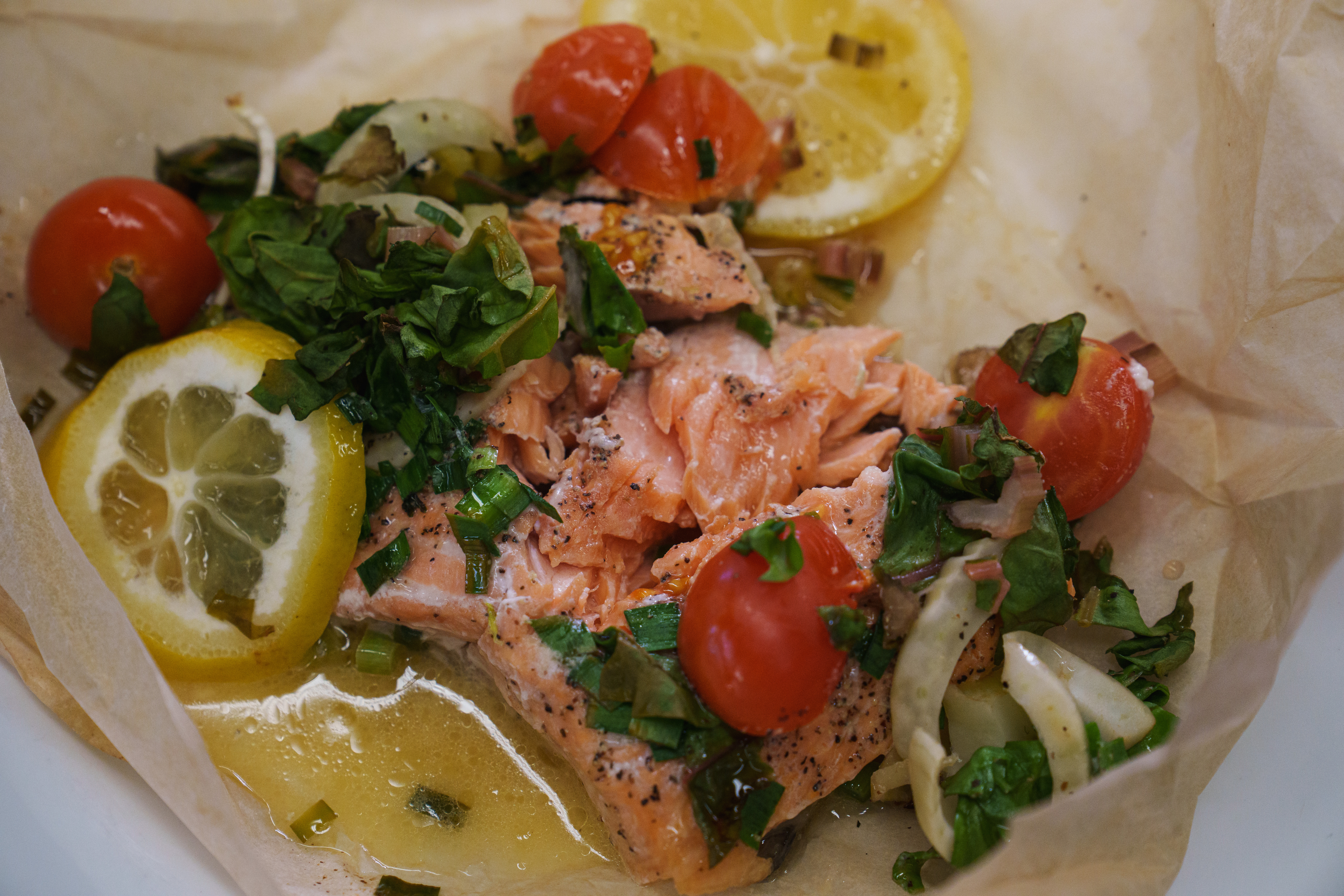
The fish dish to impress!
Impress your friends, family, or partner with this showstopper of a fish dish! Baking fish en papillote results in a healthy meal without the fishy smell.
Learn from Lecturer of Culinary Nutrition at UNH, Leah Smutko, how to use fresh and locally-sourced ingredients to make this healthy seafood dish.
Time
Prep time: 10 minutes
Cook time: 15 minutes
Overall time: 25 minutes
Cost
~ $30
Serving size
2 servings
Cookware and Tools
Cutting board
Knife
Plate
Pan
Parchment paper
oven
Ingredients

2 fillets of trout, 4 to 6 oz each, deboned, skin optional
Small amount of olive oil for fish
2 large pieces of parchment, at least double the width of the fish plus an inch
3-4 stems of chard, leaves and stems separated and washed
Half a bulb of fennel, sliced thin
3 oz cherry tomatoes, halved
1 lemon, sliced
¼ tsp of salt
Salt and black pepper, to taste
1 tbsp butter, cut into two pieces
Step-by-step cooking instructions
Preheat your oven to 400°F
Pat your fish dry.
Place your parchment pieces on a sheet tray and then place your fish filet just lightly off center on top of the parchment. You want the edges of the parchment to line up when you fold it over the fish.
Finely chop your chard stems and cut your chard leaves into ribbons.
Add your chard, fennel, and cherry tomato to the top of the fish. Lay your sliced lemon over the top. Season with salt and pepper. When seasoning, start high with a large pinch of salt and let the granules fall evenly over the whole surface of the fish and vegetables. Top with a pat of butter.
Fold the parchment over the fish so the corners line up.
Starting at the corner of the fold, bring the point of the corner up to touch the fish, creating a small fold. Crease tightly. Repeat this motion all the way around the fish to create a tightly sealed, crimped edge. It will look like an empanada. Tuck the final corner under the fish. (see video)
Bake at 400°F for 10-15 minutes depending on the thickness and preferred cook of the fish.
Open the package, being wary of the hot steam, and serve. Enjoy!
Sustainability and Education
The steelhead trout used here are harvested locally in New Hampshire, a few hundred yards off the coast of New Castle at the AquaFort. It is a sustainable, floating offshore fish farm designed at the University of New Hampshire using a method called integrated multi-trophic aquaculture (IMTA).
Production Team
Brian Yurasits
Science Communication Specialist, NH Sea Grant
Kylie Marozsan
Seafood Science Communication Doyle Fellow, NH Sea Grant
Leah Smutko
Lecturer of Culinary Nutrition, University of New Hampshire
Mark Martin and Michael Coonfield
Students, University of New Hampshire
