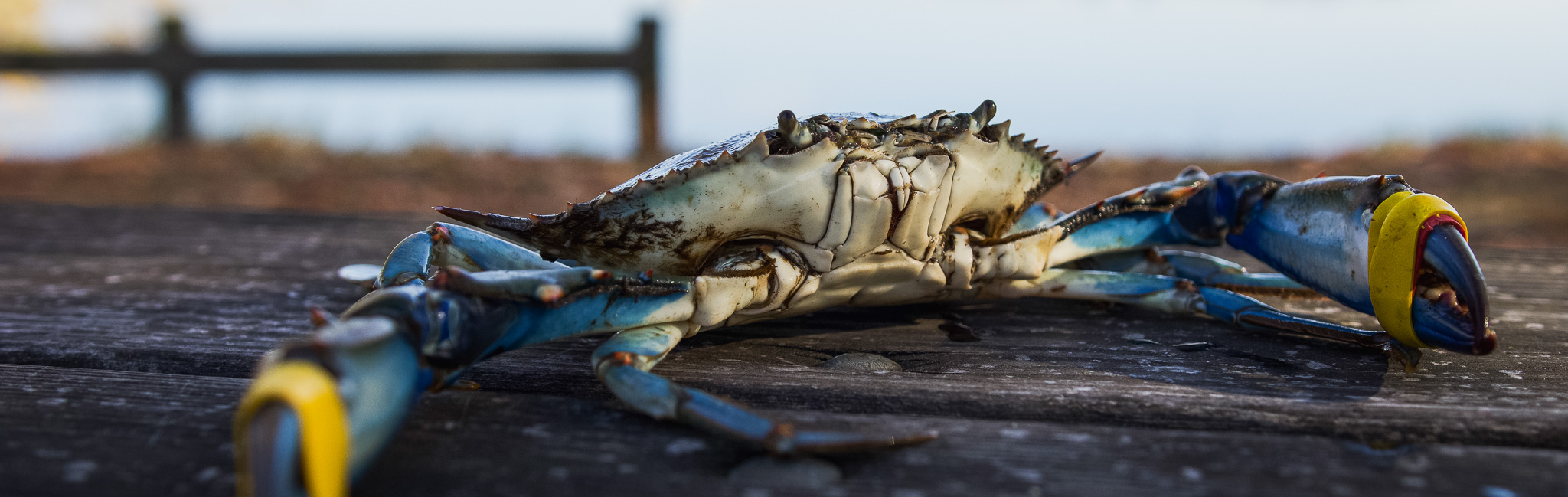
As ocean temperatures in the Gulf of Maine warm, several crab species are expanding their ranges into the Gulf of Maine and its estuaries, including New Hampshire's Great Bay Estuary. Species like the blue crab (Callinectes sapidus), once rare north of Cape Cod, are now increasingly found in New Hampshire waters as overwintering temperatures become less of a limiting factor. This range expansion of blue crabs can result in potential impacts to vital coastal habitats, as well as to economically important species like lobster and oysters. Understanding the distribution and ecological impact of blue crabs is essential to protect the ecosystem services estuaries provide and to anticipate potential challenges for fisheries and aquaculture.
This project led by Christopher Peter, Research Coordinator at the Great Bay National Estuarine Research Reserve, will investigate current and emerging crab communities in New Hampshire’s Great Bay ecosystem, with a focus on blue crabs. Researchers will implement a monitoring program that incorporates local observations and scientific sampling, assess the feeding habits of blue crabs through stable isotope and DNA analysis, and evaluate potential impacts on natural oyster beds and aquaculture operations. The project will also bring together stakeholders from across New Hampshire and Maine to share knowledge and coordinate efforts through research, education, and outreach, ultimately supporting informed management of this changing coastal ecosystem.
Principle Investigator

Christopher Peter
Research Coordinator, Great Bay National Estuarine Research Reserve
christopher.peter@wildlife.nh.gov
Co-Investigators
Alison Watts, Ph.D.
Assistant Research Professor, Department of Civil and Environmental Engineering,
University of New Hampshire
Alison.Watts@unh.edu
Gabriela Bradt, Ph.D.
Fisheries Extension Specialist, NH Sea Grant and UNH Extension
Gabriela.Bradt@unh.edu
Jason Goldstein, Ph.D.
Research Director, Wells National Estuarine Research Reserve
jgoldstein@wellsnerr.org
Jessica Batchelder
Fisheries Project Manager, Manomet Conservation Sciences
jbatchelder@manomet.org
Katharine McGovern
Biological Technician, Great Bay National Estuarine Research Reserve
katharine.a.mcgovern@wildlife.nh.gov
Project Funding Cycle
2026-2027 NH Sea Grant Biennial Research Funding
Project Abstract
Environmental change is facilitating the range expansion of crabs, particularly blue crabs (Callinectes sapidus) into coastal and estuarine waters of the Gulf of Maine, threatening native habitats, species, and fisheries. Our overarching goal for this project is to gain a better understanding of current and future crab communities in New Hampshire salt marshes and subtidal areas throughout the Great Bay ecosystem to help guide management decisions in the region. We will meet this goal through a comprehensive monitoring plan primarily for assessing blue crab populations that leverages community and industry observations; evaluating the trophic level at which blue crabs feed through stable isotope and stomach content DNA analysis of captured crabs that could impact the natural beds and aquaculture industry in Great Bay; and foster a consortium of stakeholders in New Hampshire and Maine that catalyzes knowledge sharing via collaborative research, education, and outreach.
Project News


