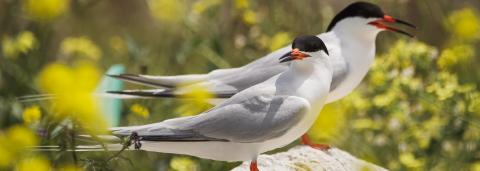
The rapidly expanding marine economy in New Hampshire may pose challenges for environmental conservation in the Gulf of Maine, particularly in regards to endangered and threatened seabirds, such as roseate terns (Sterna dougallii). Very little is known about where seabirds like terns spend their time in the Gulf of Maine, which is information that would be key to avoiding and minimizing conflict with industries, such as aquaculture and energy. To fill these key knowledge gaps, Elizabeth Craig and her team are using spatial modeling to build on prior NH Sea Grant funded research, uncovering the movements of both common and roseate terns. The results and data will be made available to both industry and state and federal regulators to help inform thoughtful decision-making throughout the region for both conservation and development.
Principle Investigator

Elizabeth Craig, Ph.D.
Director of Seabird Science, Shoals Marine Laboratory
Affiliate Faculty, Department of Biological Sciences, University of New Hampshire
Elizabeth.Craig@unh.edu
Co-Investigators
Nathan Furey, Ph.D.
Department of Biological Sciences, University of New Hampshire
Nathan.Furey@unh.edu
Donald Lyons, Ph.D.
Audubon Seabird Institute, National Audubon Society
dlyons@audubon.org
Department of Fisheries and Wildlife, Oregon State University
don.lyons@oregonstate.edu
Project Funding Cycle
2024-2025 NH Sea Grant Biennial Research Funding
Project Abstract
The marine economy in New Hampshire and surrounding Gulf of Maine waters is changing and developing, particularly in industries of energy and aquaculture. However, coastal and offshore development may pose significant challenges for marine environmental conservation. Despite the ecological importance of seabird species in this region, there is little information on the spatial distribution or movements of seabirds in coastal and offshore environments, particularly for the roseate tern which is the only federally endangered bird species occupying Gulf of Maine waters. Information on the spatial distribution of endangered species is critical for industries and regulatory agencies to make informed siting decisions that will minimize impacts to sensitive wildlife. Our proposed research aims to fill key information gaps about seabird distribution and movement, building upon prior work funded by NH Sea Grant, with the aim of informing marine spatial planning processes in our region. Using a spatial suitability modeling approach, this study will explore habitat use, movements, and occupancy patterns of both common and roseate terns during the summer breeding season and post-breeding staging period during which these birds occupy Gulf of Maine waters. By incorporating environmental and habitat-based parameters, our research will provide valuable insights into the distinct spatial requirements and behaviors of these species. Our proactive data sharing, outreach and networking approach will ensure that data are accessible to industry and will empower state and federal wildlife agencies to make well-informed regulatory decisions and recommendations. Our research not only contributes to the conservation of threatened and endangered seabirds but also supports the development of more sustainable coastal and offshore infrastructure. Finally, our work will advance environmental literacy and workforce development through training of graduate and undergraduate students and collaboration with local education organizations, fostering a deeper understanding and appreciation in our community for the interconnectedness of seabirds, marine ecosystems, and our marine economy.
Project News


