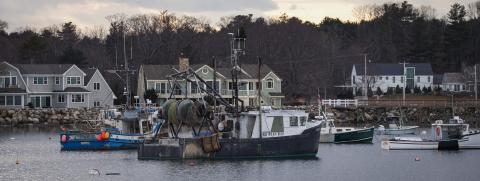
Understanding who participates in New Hampshire’s growing seafood workforce is key to building a stronger seafood economy. Currently, there is little detailed information about the workers involved, including their demographics, as well as potential barriers and opportunities in the labor force. This research will take a deep dive into the seafood production sector, compiling existing data and conducting surveys to build a more accurate picture of the people behind the industry.
Using New Hampshire seafood as a case study, Easton White, Assistant Professor in the Department of Biological Sciences at the University of New Hampshire, and his team will identify gaps in workforce participation and highlight opportunities to grow and strengthen the seafood industry. Findings will be shared through outreach seminars, a technical report, and an online data tool to inform future policy and business decisions. The project will support several early-career researchers from different disciplines, a Ph.D. Student, and a pair of undergraduate interns.
Principle Investigator

Easton White, Ph.D.
Department of Biological Sciences, University of New Hampshire
Easton.White@unh.edu
Co-Investigators
Gabriela Bradt, Ph.D.
NH Sea Grant & UNH Extension
Gabriela.Bradt@unh.edu
Sherman Bigornia, Ph.D.
Department of Agriculture, Nutrition, and Food Systems, University of New Hampshire
Sherman.Bigornia@unh.edu
Joshua Stoll, Ph.D.
School of Marine Sciences, University of Maine
Joshua.Stoll@maine.edu
Project Funding Cycle
2024-2025 NH Sea Grant Biennial Research Funding
Project Abstract
The Seafood Economy encompasses a wide array of activities, including recreational and commercial fishing, recreation and tourism, energy production, and aquaculture. The breadth of sectors within the seafood economy also presents a challenge for understanding the demographics of those that work within the seafood economy. Current approaches generate coarse estimates of the number of workers or average wages lumped together across broad categories. For example, even within the broad sector of seafood production, we do not have estimates of how many workers, and certainly not their demographics, there are in New England. As the seafood economy continues to grow, it is essential we understand the demographics of those involved to build a stronger seafood pipeline. In addition, we need to understand potential barriers and opportunities in the labor force to fully unlock the seafood economy. To address these data gaps, we will use New Hampshire seafood as a case study to address three aims: 1) Collate existing demographic data on New Hampshire’s seafood sector, 2) Conduct in-person and online surveys to gain a more detailed and comprehensive demographic picture, especially in relation to seafood, and 3) Conduct outreach seminars with key stakeholders and produce a technical report and online data tool. Collectively, this data will provide a baseline for managers and local businesses and help identify opportunities. The project will support several early-career researchers from different disciplines, a Ph.D. Student, and a pair of undergraduate interns.

