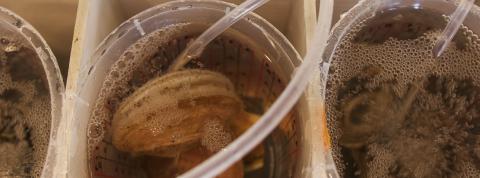
As New Hampshire’s shellfish industry continues to grow, understanding how ocean warming and acidification may impact shellfish safety and sustainability is increasingly important. Shellfish provide vital ecosystem services, such as improving water quality, but they can also accumulate harmful toxins when feeding on certain algae. These toxins, including those that cause paralytic shellfish poisoning (PSP), can pose serious health risks to humans and lead to temporary harvesting closures that impact the economy.
Brittany Jellison at the University of New Hampshire is investigating how ocean warming and acidification—two major stressors in the Gulf of Maine—affect the feeding behavior, food selectivity, and toxin accumulation in three commercially important bivalve species: oysters, mussels, and scallops. By exploring how these changes may influence the potential for toxin buildup, the project will help inform safe harvesting practices and shellfish management strategies in a changing Gulf of Maine. In addition to the scientific research, the project includes an educational outreach component that introduces K–5 students, particularly those in inland areas of New Hampshire, to the importance of shellfish and phytoplankton through hands-on marine science activities.
Principle Investigator

Brittany Jellison, Ph.D.
Department of Biological Sciences, University of New Hampshire
Brittany.Jellison@unh.edu
Co-Investigator
Elizabeth Harvey, Ph.D.
Department of Biological Sciences, University of New Hampshire
Elizabeth.Harvey@unh.edu
Project Funding Cycle
2024-2025 NH Sea Grant Biennial Research Funding
Project Abstract
The shellfish industry is on the rise in New Hampshire and the species within this industry provide many important ecosystem services such as increasing water quality through filter feeding, however they can also accumulate biotoxins through feeding on toxin-producing algae such as paralytic shellfish poisons (PSP) which can be harmful if consumed by humans. Monitoring efforts are in place to measure harmful algal bloom formation and toxin levels, and harvesting is temporarily closed when toxin levels exceed regulatory limits. However, these closures can have economic costs. Different bivalve species vary in their feeding behavior and toxin accumulation however, these species will be exposed to warming and acidification in a future Gulf of Maine, which can impact shellfish physiology including feeding activity. This research aims to assess the effects of ocean warming and acidification on feeding behavior, food selectivity, and toxin accumulation, in three commercially important bivalve species. The objectives include investigating the influence of warming and acidification on feeding behavior and assessing if altered behavior leads to differences in toxin accumulation between species.
Additionally, outreach work is proposed that will raise the profile of the importance of shellfish and phytoplankton for K-5 students and provide students that reside in non-coastal parts of New Hampshire a fun, interactive marine-focused experience. By studying the feeding behavior and food selectivity of different bivalve species under varying environmental stressors, we will provide insights into how these species will be impacted by predicted increases in harmful algae blooms due to changes in ocean acidification and ocean warming in the Great Bay Estuary and the Gulf of Maine. The results of this study will provide critical information for the management of the growing shellfish industry in New Hampshire, helping to protect human health while minimizing economic impacts.

